We made a trip with our friends, Tyler and Michele Campbell to see the famous dinosaur trackway in the Paluxy River at Glenrose, TX. We first visited the well-known Creation Evidence Museum and got to speak with its founder Carl Baugh. Note the polystrate tree display right outside the museum. It is a really good simulation of the famous one Ruby and I and Joe Hubbard located and made measurements of outside Wartburg TN in 2024. This simulation was just one of the polystrate trees at that location. Remember, polystrate just means a fossils that goes through many (poly) layers (strata). These fossilized trees are one of the strongest arguments against geologic evolution as they cross supposed millions of years of sediment deposition. Is it possible for a tree to remain standing that long without decomposing? We have found many polystrate tree fossils and they are always missing roots, branches and usually missing their bark. Check out findings at Mt St Helens for an explanation.
Inside the museum we got to see the actual fossils of the dinosaur tracks with human foot prints. These are VERY controversial even among creationist. My take on these is that the testimonies of locals that their relatives created these human foot prints during the depression to make money off of tourist is probably how they were created. I do believe that Dr. Baugh is a sincere creation scientists who has done extraordinary and legitimate research in various areas but there were too many inconsistencies between the so-called human prints and what a real human print would look like. To demonstrate this discrepancy, while we were there I pressed my foot into mud and made several prints, some walking-some while straining to open my toes apart, and the prints just do not match those found with the dinosaur tracks. But I encourage you to visit the site and decide for yourself. One thing is certain; humans and dinosaurs were on the earth at the same time so it is possible to have their prints together. See our Thought Provoking Truths for details.
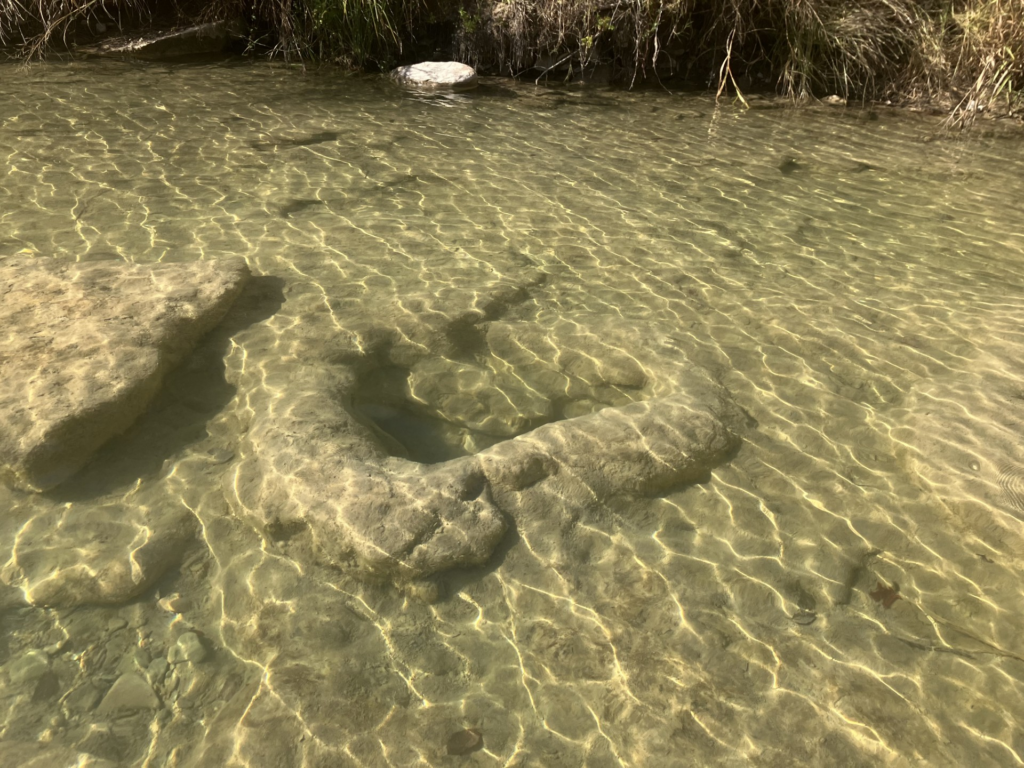
Next we went to the State Park and waded the Paluxy River. There were many tracks in the creek and some were huge three-toed tracks. There were many deep tracks that were clearly made in soft mud as the displaced mud was raised around the depression of the foot. It was really cool standing in fossil tracks of a dinosaur but how do you get a track to fossilize without being washed away. Do your tracks on the beach or in a creek get washed away or do they stay in place for hundreds to thousands of years until they are buried deep enough to fossilize? These were clearly made in soft mud and had to be buried rapidly and deeply to fossilize before being washed away. These are also formed in limestone, an ocean sediment.
On our way back to Little Rock we stopped at Nashville AR to see the only remaining dinosaur track from what was once the largest trackway in the world. The trackway was found in a limestone rock quarry. A few of the tracks were cut out and sent to museums but the rest were quarried and/or deteriorated by exposure. Today only one remains at a park in the town and it is badly deteriorated. So even after the dinosaur tracks are buried rapidly and deeply so they can be turned into stone, these trace fossils (tracks) will deteriorate rapidly if exposed to surface conditions.


Your support of this ministry makes trips like this possible. Please consider supporting this ministry so we can visit more trackways across the USA.