
Old Earth is a Lie
You are of your father the devil, and the desires of your father you want to do. He was a murderer from the beginning, and does not stand in the truth, because there is no truth in him. When he speaks a lie, he speaks from his own resources, for he is a liar and the father of it. John 8:44
Explore this question about the age of the fossils
Hasn’t science proven the earth is old? Afterall, doesn’t radioactive age-dating prove its old?
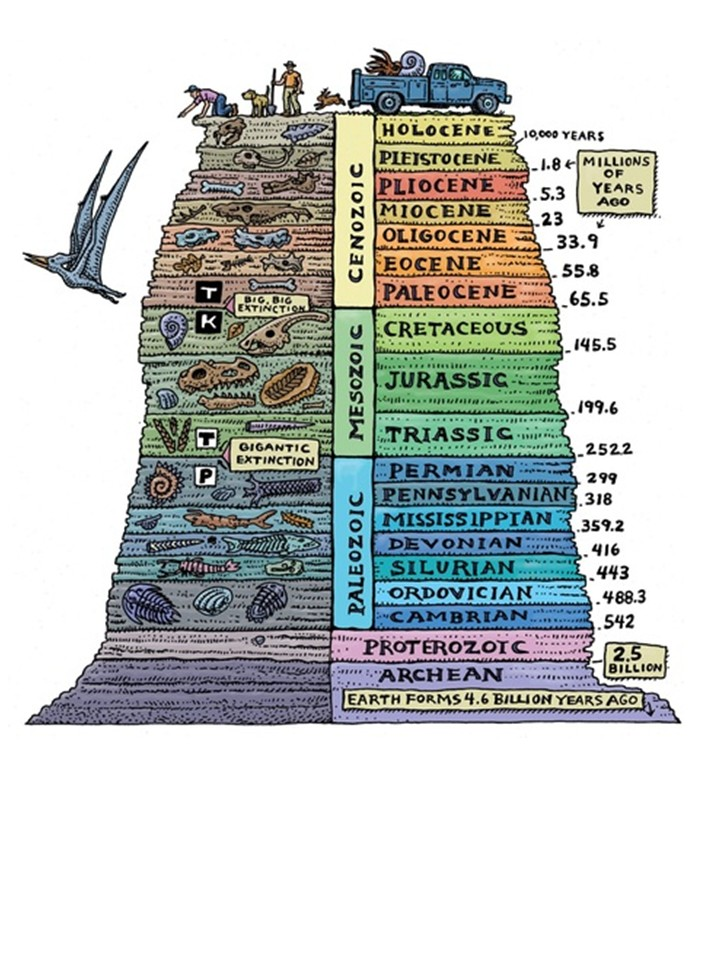
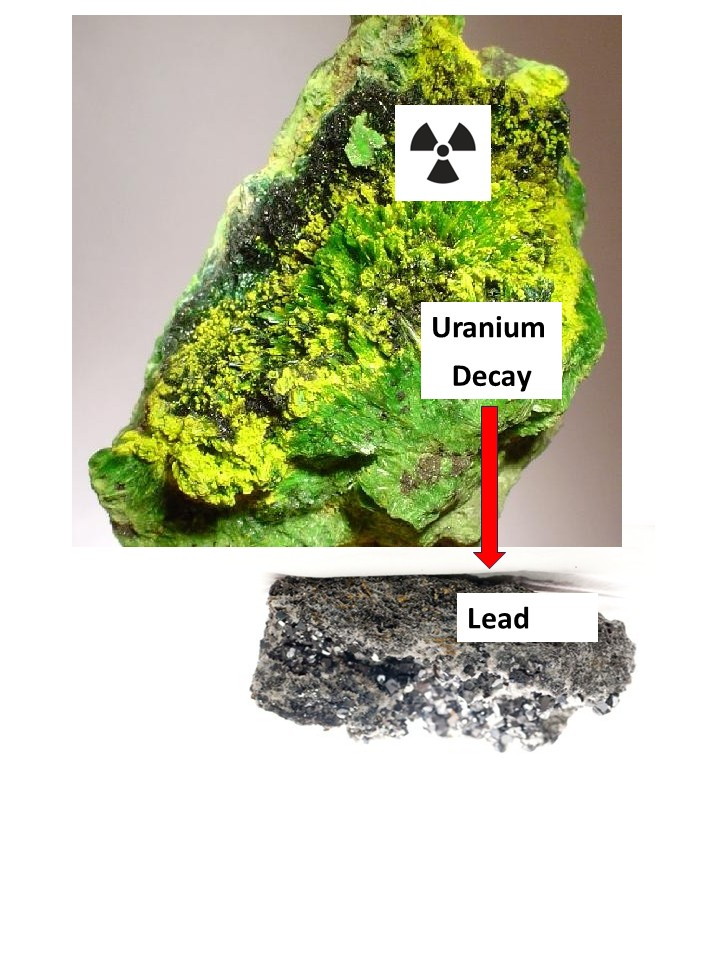
When you find a rock, does the rock have a label saying how old it is? No! So how do we know how old the rocks are? Secular scientist claim that their relative age is determined by index fossils associated with the layer but the absolute or exact age is determined by radioactive dating. But is that true? Did you know that the ages of rocks were assigned to them over 100 years before radioactivity was discovered. Did you know that when rocks are sent for radioactive analysis you must tell them the layer that the sample came from so they know what the relative age s before doing the analysis. Did you also know that when rocks of known age are analyzed the test disprove the methods. Lets learn why.
Radioisotopes decay from an unstable parent product, such as Uranium-238, to a stable daughter product, such as lead-206, by giving off radioisotopes (alpha radiation). The time for half of the uranium-238 to decay is the half-life. The theory is that by measuring the amount of U-238 and Lead-206 at a point in time, and knowing the half-life (rate of decay) one can calculate the time it had been decaying. But this makes 3 basic assumptions which may or may not be valid.
Thought Provoking Assumptions
1
Daughter Products
When specimen was formed there were no daughter products or the original quantity of parent and daughter must be known.
2
Half-Life
The rate of decay has been constant throughout the entire time the sample has existed.
3
Closed System
The quantity of parent or daughter atoms has not been altered by outside contamination. The specimen is a ‘Closed System;’ nothing in/nothing out.
Case 1

What if you had a 30 gallon bathtub with a faucet dripping at 1 gallon per minute and you observed that there was 15 gallons in the tub, how long had it been dripping?
IF you said 15 minutes you might be right, But you MIGHT be TOTALLY WRONG!
Case 2

What if there was 5 gallons in the tub before it started dripping? OR what if the shower was also dripping at 1 gallon per minute? Would that change how long it took to get 15 gallons in the tub when you observed it?
IF you said 5 minutes you might be right, But again you MIGHT be TOTALLY WRONG!
Case 3

What if the tub was leaking at 1 gallon per hour? Would that change how long it took to get 15 gallons in the tub?
You have to know the dripping rate (half-life), how much was already present (starting amount), and no other sources in or out (a closed system).

Rates of Decay have not been constant!
Purdue physicist Ephraim Fischbach noticed a change in the radioactive decay rate tied to a solar flare and to Earth’s annual orbit
“The unusual decay change has happened during 10 solar flares since 2006.” R. Boyle (Science 2012)
Are These 3 Assumptions Valid?
-Radioisotopes decay rates have only been measured for a little more than 100 years yet these rates are extended out to millions of years outside the range of data based upon. This is a violation of regression (statistics) analysis principles.
-Recent research (references 1-4) has shown that decay rates are not constant but are affected by natural factors such as solar flares.
-Essentially all fossils are found in sedimentary rock which is not a closed system (permeable material) and therefore not valid for radiometric age dating because parent and daughter atoms can be transported into and leached out of the samples.
-No one was around supposed millions of years ago to sample the original rock to know what the starting amount was. It is assumed zero but is this valid?
1 Thes 5:21 “Examine (test) everything carefully, hold fast to that which is good”
Test Rocks of Known Age
A team of Young-Earth Creation scientists conducted the RATE project in which they collected igneous rocks of known ages from volcanoes around the world and sent them to well-respected laboratories. See references 5-7.
| Volcanic Eruption | Year When formed | Radiometric date |
| Mt Etna, Sicily | 1792 | 0.35 mill. Years |
| Mount St Helens, WA | 1986 | 2.8 mill. years |
| Hualalai, Hawaii | 1800-1801 | 1.6 mill. years |
| Mt Ngauruhoe, NZ | 1954 | 3.5 mill. Years |
| Kilauea Iki, Hawaii | 1959 | 8.5 mill. Years |
| Sunset Crater, AZ | 1064-65 | 0.27 mill. years |
| Mt Stromboli | 1963 | 2.4 mill. Years |
| Medicine Lake | <500 years | 12.6 mill years |
Not only did the rocks formed in modern times produce erroneous dates, but the different radiometric methods did not agree with each other.
The RATE team sent 20 samples from each of 4 geologic formations to be tested using the Isochron method, based upon four methods: Potassium (K)-Argon (Ar); Rubidium (Rb)-Strontium (Sr); Samarium (Sm)-Neodymium (Nd); Uranium (U)-Lead (Pb). The findings below are in millions of years (ma).
| Method | Diabase Sill Ma | Basalt Ma | Amphibolite ma | Granite ma |
| 40K – 40Ar – 36Ar | 841 | 516 | ||
| 87Rb – 87Sr – 86Sr | 1,060 | 1,111 | 1240 | 1512 |
| 147Sm – 143Nd– 144Nd | 1,379 | 1,588 | 1655 | 1664 |
| 238U – 206Pb – 204Pb | 1,250 | 1883 | 1933 |
Findings:
-The different radioisotope methods produced VASTLY different ages for the same rock layer.
-Alpha decay ( U & Sm) always gave older ages than Beta decay (K & Rb).
-Heavier atoms (U-238, SM-147) gave older ages than lighter atoms (Rb-86, K-40).
-Longer the half-life the older the ages predicted.
“If you cannot trust the dates on known volcanoes why trust the method elsewhere” Ham and Hodge (8)
References
1. “Analysis of Environmental Influences in Nuclear Half-Life Measurements Exhibiting Time-Dependent Decay Rates”, J.H. Jenkins, D.W. Mundy, and E. Fischbach, Nucl. Instr. and Meth. A (2010), doi: 10.1016/j.nima.2010.03.129.
2. “Evidence of Correlations Between Nuclear Decay Rates and Earth-Sun Distance”, J.H. Jenkins, E. Fischbach, J.B. Buncher, J.T. Gruenwald, D.E. Krause, and J.J. Mattes, Astropart. Phys. 32, 42-46 (2009).
3. “Time-Dependent Nuclear Decay Parameters: New Evidence for New Forces? “, E. Fischbach, J.B. Buncher, J.T. Gruenwald, J.H. Jenkins, D.E. Krause, J.J. Mattes and J.R. Newport, Space Sci. Rev., 145, 285-335 (2009).
4. “Perturbation of Nuclear Decay rates During the Solar Flare of 2006 December 13”, J.H. Jenkins and E. Fischbach, Astropart. Phys. 31, 407-411 (2009).
5. Vardiman, L., A. A. Snelling and E. F. Chaffin, eds. 2000. Radioisotopes and the Age of the Earth: A Young-Earth Creationist Research Initiative. El Cajon, CA: Institute for Creation Research and St. Joseph, MO: Creation Research Society.
6. Vardiman, L., A. A. Snelling and E. F. Chaffin, eds. 2005. Radioisotopes and the Age of the Earth: Results of a Young-Earth Research Initiative. El Cajon, CA: Institute for Creation Research and Chino Valley, AZ: Creation Research Society.
7. DeYoung, D. B. 2005. Thousands Not Billions: Challenging an Icon of Evolution, Questioning the Age of the Earth. Green Forest, AR: Master Books.
8. Ham, K., and B. Hodge. 2016. A Flood of Evidence: 40 Reasons Noah and the Ark Still Matter. Green Forest, AR: Master Books.