Engage with Thought-Provoking Insights
Explore compelling content that bridges Biblical truths with scientific discovery, enriching your faith and knowledge.
Explore this question about the Gulf of Mexico
Question: Why is Cuba an Island? If the Gulf of Mexico is 300 million years old, why can’t I drive there from New Orleans, LA or Mobile, AL?
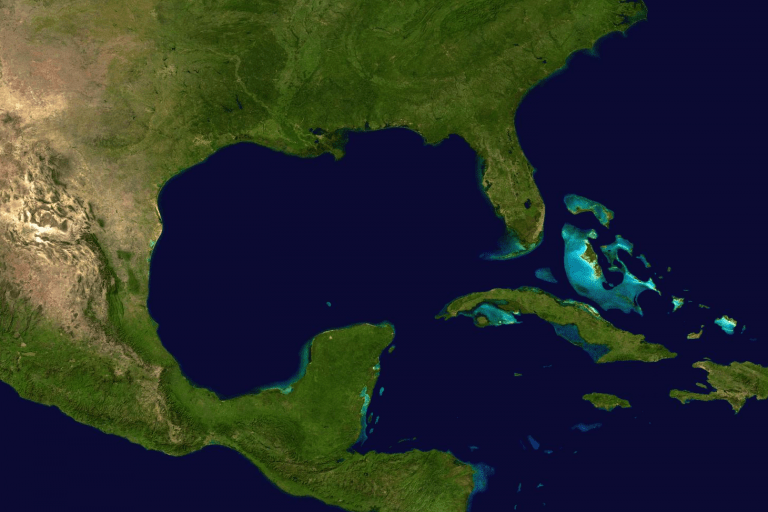
That is a very good question although it would seem to be a ridiculous question. Afterall, Cuba is an island at the eastern boundary of the Gulf of Mexico (GoM) and the Caribbean. The GoM basin is approximately 1.6 million square kilometers or 615,000 square miles. It is believed by secular geologist to have formed approximately 300 million years ago. Is this true or was it formed 4,500 years ago during the world-wide deluge and catastrophic plate tectonics associated with Noah’s Flood?
What we know is that almost half of the GoM basin is a shallow continental shelf. The basin contains a volume of roughly 2.5 million kilometers, which is 660 quadrillion US gallons. The US portion of the GoM coastline spans 1,680 miles (2,700 km), receiving runoff waters from 33 rivers that drain 31 states.
The largest contributor of water and sediment is by far the Mississippi River. The U.S. Army Corps of Engineers has been measuring sediment loads exiting the Mississippi River for decades but not centuries much less millennia. What they found is that sediment loads were much higher in the past and decreased significantly between 1950 and 1966 then leveled out to around 436,000 tons per day or 159 million tons per year. It has been estimated that the sediment load in the past was double what it is today.
Thought Provoking Assumptions
1
Size of the GoM basin
The Gulf of Mexico basin is the size of 2.5 million cubic km
2
Sediment Density
Sediment filled the basin to a bulk density of 1.8 Mg per cubic meter.
3
Contributing Rivers
Only the Mississippi Rivers contributes sediment into the GoM basin.
4
Sediment Load
The sediment load enters the basin at 150 million tons per year.
So, let’s do a little math to calculate the time it would take for the Mississippi River alone to fill the GoM.
The assumed bulk density of 1.8 Mg per cubic meter is so high that I don’t recall in my 40-year career as a soil scientist ever measuring a soil profile with a higher density. At that density, 2.5 million km3 x 1.8 trillion Mg/km3 = 4.5 quadrillion Mg of sediment to fill it completely such that we could drive from New Orleans to Cuba. That is a lot of sediment that can be stored in the basin.
How long would it take to fill the GoM basin with sediment? 4.5 Quadrillion Mg/150 million Mg/yr = 30 million years. So, the GoM should have filled up 270 million years ago. But if the sediment load was twice as high in the past then it should have filled in within 15 million years or 285 million years ago. Then why can’t we drive to Cuba?
This is consistent with other erosion measurements around the world. If the Earth is 4.5 BILLION years old, where is the sediment? At present erosion rates, all the sediment in the ocean would accumulate in no more than 14 million years. Ariel A. Roth wrote that “the present rate of erosion of our continents by rain and consequent (transport) into the oceans is so rapid that we would expect the continents to be eroded down to sea level in about 10 million years.” We shouldn’t have any land left above the oceans.
Are our soil erosion and sediment transport scientists’ way off, or is the earth just not as old as we have been led to believe?

Discover Insightful Truths with CSM
The question of why is Cuba an island is clear. Its an island because the earth is young! Sediment data supports the Bible’s timeline of a young earth!
The Bible is consistent with Science. Simple math confirms the Bible account.